REVIEW · MUSCAT
Private Full-Day Muscat City Tour
Book on Viator →Operated by Discover Mazoon Tours Oman · Bookable on Viator
Muscat hits hard in one day. I love the Sultan Qaboos Grand Mosque for its scale and the jaw-dropping details, and I also love the Mutrah Souq + fort area for that real harbor-side, Old Muscat feel. One thing to plan for: it’s a long 7–8 hour day, and at least a couple of stops are mainly for photos rather than inside exploring.
What makes this tour work is the mix of big-ticket sights and everyday city life. You’ll start with the mosque, then roll through the Al Qurum beach drive, land at the Mutrah fish and vegetable market where locals buy and sell fresh seafood, and keep moving through Old Muscat without the day feeling rushed or chaotic.
This is a private tour, so you travel only with your group and follow the pace set by your guide. It’s also not stroller accessible, so if you’re traveling with mobility needs, plan around that.
In This Review
- Key things that make this Muscat tour worth your time
- How the day flows: from ministries and embassies to Old Muscat
- Sultan Qaboos Grand Mosque: the scale hits first, then the details get better
- A quick stop with local energy: Mutrah Fish and Vegetables Market
- Mutrah Souq: Old-trade lanes by the harbor
- Mutrah Fort: Portuguese layers, Omani restoration, and sea-and-ridge defense
- Bait Al Zubair Museum: culture and royal-family context in a focused stop
- Al Alam Palace: gold-and-blue royal architecture, and why you only get the gate view
- Jalali and Mirani Forts: Portuguese-built harbor defense, photo stop only
- Royal Opera House in Muscat: classical arts, contemporary Omani design
- Price and value at $259: what you’re really paying for
- Who should book this Muscat city tour
- Should you book it? My honest take
- FAQ
- How long is the Private Full-Day Muscat City Tour?
- What time does the tour start?
- Is pickup available?
- Is this tour private?
- Which stops include admission tickets?
- What’s the cancellation policy?
Key things that make this Muscat tour worth your time
- Sultan Qaboos Grand Mosque on an enormous footprint with five minarets and a central dome over 50 meters high
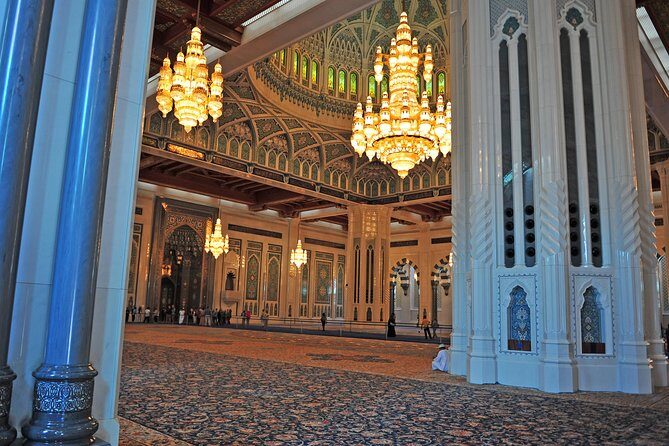
- A prayer carpet made for superlatives: 21 tons and 28 colors, plus a Swarovski crystal chandelier about 14 meters long
- Mutrah Fish and Vegetable Market where you see locals trading fresh fish and seafood
- Mutrah Souq’s old-trade story tied to routes toward India and China, right by the harbor
- Photo-friendly viewpoints at Jalali and Mirani Forts right behind Al Alam Palace (fort access isn’t part of this stop)
How the day flows: from ministries and embassies to Old Muscat
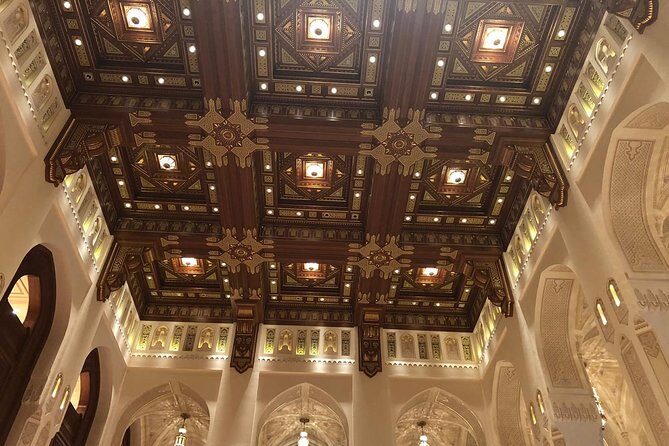
Your day starts at 8:30 am, and you’re out for about 7 to 8 hours total. That long stretch matters because Muscat is a mix of locations: monumental modern landmarks, formal royal sites, and working markets, all spread out enough that a planned route saves time.
The route also gives you a helpful contrast. After the mosque, you’ll drive through a part of the city that’s busy with ministries and embassies, then you’ll pass along Al Qurum Beach Street on the way to Mutrah. It’s a nice reminder that Muscat isn’t just forts and palaces—it’s also a living city with everyday rhythms.
This tour is private, and that usually means the guide can keep timing smooth: fewer waiting games, and more “go see it while it still feels fresh.” You also get a mobile ticket, which helps on the day-of logistics.
You can also read our reviews of more city tours in Muscat

Sultan Qaboos Grand Mosque: the scale hits first, then the details get better
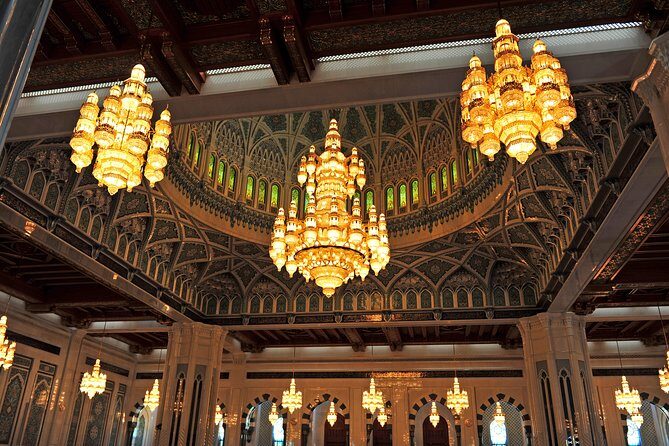
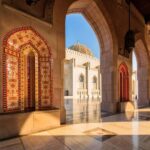
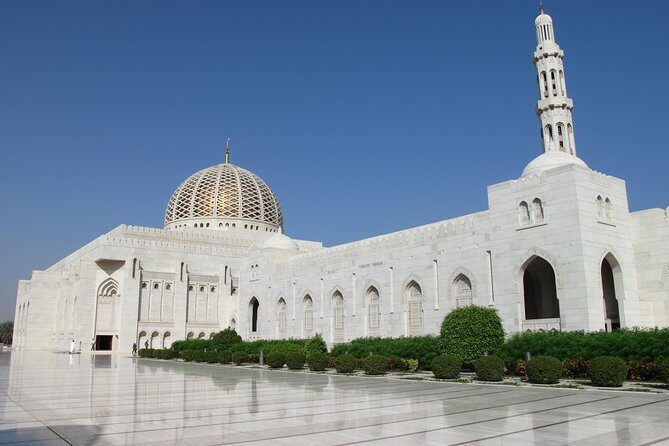
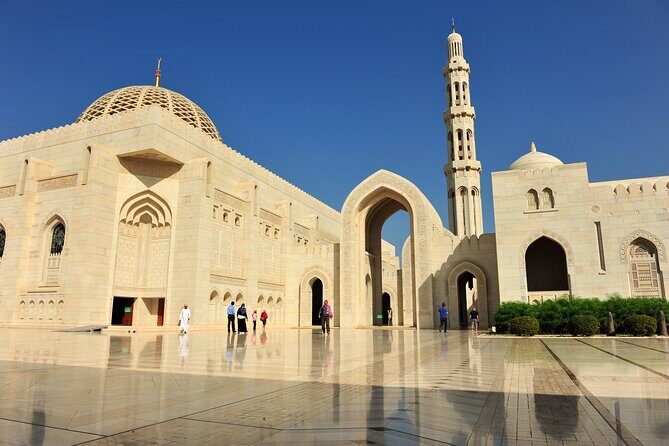
The Sultan Qaboos Grand Mosque is built on a massive site—416,000 m²—plus a complex area of about 40,000 m². It was inaugurated on May 4, 2001, so this place isn’t “old museum” old. It’s modern Oman honoring tradition, and the size makes that clear fast.
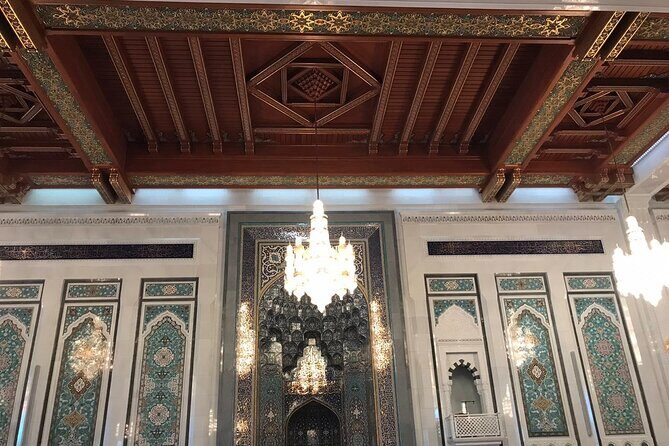
From the outside, you notice the five minarets. The tallest main minaret reaches about 90 meters, and that height is the kind of feature you feel even before you reach the prayer area. Then you step into the prayer hall and the numbers keep coming: it’s square, roughly 74.4 by 74.4 meters, and the central dome rises about 50 meters above the floor.
The mosque’s main Musalla (prayer room) can hold over 6,500 worshippers, which helps you understand why this isn’t just a “pretty building.” It’s designed for real use at real scale. If you like architecture and sacred space that feels functional, not staged, you’ll appreciate that.
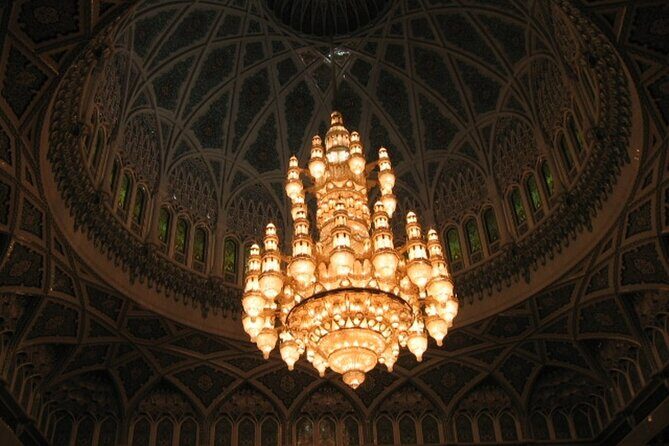
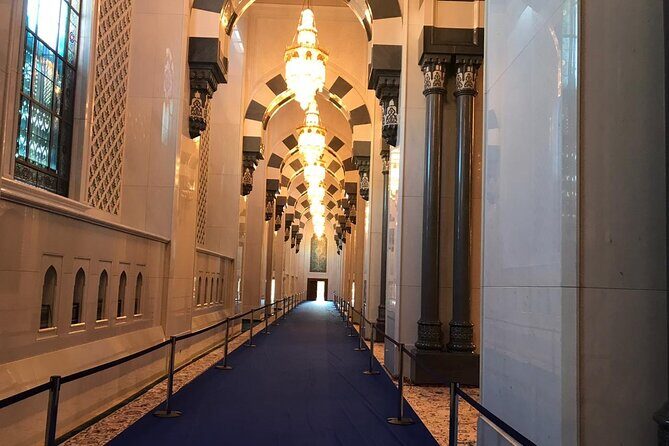
Now for the part that tends to stop people mid-walk: the interior prayer carpet. It’s described as 21 tons in weight and 28 colors, and the overall interior decoration is intentionally dramatic. The Swarovski crystal chandelier is also a standout detail—about 14 meters in length—so if you’re the type who looks up instead of forward, you’re going to be rewarded.
A quick stop with local energy: Mutrah Fish and Vegetables Market
Next comes a very different vibe. The Mutrah Fish and Vegetables Market is one of those places where the point is the scene itself: local people buying and selling fresh fish and seafood. You’re not just looking at stalls; you’re seeing the working market rhythm.
It’s a short stop—about 20 minutes—and that’s actually a good fit. You get enough time to walk through, spot what’s on offer, and understand what locals are focused on that day without turning it into a long production.
This is also one of those stops that helps your whole day feel more “Muscat” and less like a checklist. The mosque gives you Oman’s spiritual grandeur, then the market brings you back to daily life—networks of boats, fresh supply, and people negotiating in real time.
Mutrah Souq: Old-trade lanes by the harbor
From the market, you head to Mutrah Souq, Oman’s largest traditional souq. This place dates back around 200 years and sits right next to the harbor. That location matters because historically it became a trading hub on routes toward India and China.
Even the way the souq is described tells you something about the feel of walking there. The name is tied to the idea of darkness—crowded stalls and narrow lanes where sunrays don’t reach easily during the day, and shoppers need lamps to find their way. Today, you’ll still feel the narrow-lane density, especially if you move deeper into the market area.
This stop is about an hour, which is a sweet spot. You can wander without getting lost for too long, and you can also see enough of the market variety to understand it’s more than one type of shop. The harbor adjacency also means the area has that salty, coastal atmosphere that you don’t get inland.
Mutrah Fort: Portuguese layers, Omani restoration, and sea-and-ridge defense
After the souq, you visit Mutrah Fort for about 30 minutes, and entry is included. It sits on a mountain ridge overlooking both the city and the bay of Mutrah, with towers and ramparts shaped for defense.
What’s interesting here is the strategic logic. The fort’s position was ideal for protecting Mutrah from attacks from both the sea and inland. In other words, you can read the terrain as part of the plan.
The fort’s timeline is also a story of who had influence at different points. It’s said to have been built around 1507, then the Portuguese added towers and a curtain wall in the later 18th century. Under the Al Busaidi dynasty, the curtain walls were doubled and more towers added. Finally, the fort was restored by the Ministry of Heritage and Culture in 1980.
That combination helps you see the fort as more than a single era monument. If you like military architecture or layered history, you’ll probably enjoy how much you can infer just from the setting and the defensive layout.
You can also read our reviews of more private tours in Muscat





Bait Al Zubair Museum: culture and royal-family context in a focused stop
From the fort, you move to Bait Al Zubair Museum, where you’ll spend about 30 minutes. Admission is included, and the museum’s mission is straightforward: it tells the civilization and culture of Oman, plus information about the history of the Royal Family.
This is one of those stops that can make the rest of the day click. After you’ve seen mosque grandeur, harbor trade life, and fort defenses, the museum offers the “why” behind what you’re looking at—especially when it comes to how royal authority ties into national identity and heritage.
Because the stop is limited to about half an hour, you’ll want to focus on the parts that match your interests. If you’re curious about how monarchy and culture are connected in Oman, you’ll likely leave with a clearer mental map than you started with.
Al Alam Palace: gold-and-blue royal architecture, and why you only get the gate view
Next is Al Alam Palace in Old Muscat. The palace has a history over 200 years, and the existing structure—described with a facade of gold and blue—was rebuilt as a royal residence in 1972.
It’s said the palace was built under the watch of Imam Sultan bin Ahmed, who is described as the 7th direct great-grandfather of Sultan Haitham. That kind of lineage detail is useful, because it signals that this isn’t simply a pretty façade for visitors. It’s connected to long-running political and family continuity.
Now the practical part: the inner grounds of the palace remain off-limits. You can stop near the gates and take photographs, and the palace is used for official functions and receives distinguished visitors. In other words, plan to enjoy the exterior and the moment, not a full stroll.
You’ll also likely appreciate the contrast: the palace feels elegant but humble in design, and that balance is part of why it works as an “Old Muscat” stop right after the fort and museum.
Jalali and Mirani Forts: Portuguese-built harbor defense, photo stop only
Just behind the palace area are Jalali and Mirani Forts, watching over the harbor of Old Muscat. These forts were built by the Portuguese in 1580 on an earlier Omani fortress to protect the harbor after Muscat had twice been sacked by Ottoman forces. Omani forces regained control in 1650.
Then came more conflict and shifting control. During civil wars between 1718 and 1747, the forts were captured by Persians who had been invited to assist rival imams. Later, the fort was extensively rebuilt again.
In your time on this tour, though, you should treat this as a picture stop. Both forts are noted as not open for visitors, so you’ll want to focus on getting good views from outside rather than planning on entrance.
This is a smart use of time. You still get the defensive-harbor story and the visual context, without losing time to places you can’t go inside.
Royal Opera House in Muscat: classical arts, contemporary Omani design
The final big stop is Royal Opera House, with admission included and about 30 minutes on-site. Sultan Qaboos bin Said Al Said Al Said ordered the building in 2001, and it officially opened on October 12, 2011.
This place reflects contemporary Omani architecture, and it has a capacity for up to 1,100 people. The complex includes a concert theater, an auditorium, landscaped gardens, and a cultural market area with retail and luxury restaurants. There’s also an art center designed for musical, theatrical, and operatic productions.
Even if you’re not catching a performance that day, it’s a good ending because it shifts the focus from heritage sites to a modern cultural institution. It helps explain how Oman invests in arts infrastructure, not only monuments and defenses.
A practical tip: because this stop is relatively short, walk the exterior and keep moving. If you pause too long at just one view, you’ll run out of time before you see enough of the complex to feel like you finished the story.
Price and value at $259: what you’re really paying for
At $259 per person for a private full day, you’re paying for two things: transport time and a tight, guided sequence of key locations.
Here’s the value logic that matters:
- You get pickup offered, which is a big deal in Muscat where distances can stack up fast.
- Several stops don’t charge admission (Grand Mosque, fish market, Mutrah Souq, Al Alam Palace gate area, and the photo stop at the harbor forts).
- Some stops do include admission, including Mutrah Fort, Bait Al Zubair Museum, and Royal Opera House.
So your money isn’t only covering driving and narration. It also covers entry where it counts, and it keeps you from wasting half a day figuring out how to connect sites on your own.
If you like structure, this works well. If you prefer total free time with no schedule at all, then a private guide might feel too “planned.” But if you want maximum Oman in one day with minimum hassle, this price starts to look reasonable.
One more reality check: it’s weather-dependent. Muscat can be bright and hot, so keep an eye on conditions. If the tour needs to shift due to poor weather, you should be ready for date changes or a full refund offer.
Who should book this Muscat city tour
This is a strong match if you want:
- a high-contrast day (mosque grandeur, working market life, fort defense views, royal architecture, modern arts)
- a private guide who keeps the flow smooth
- a day that covers both Old Muscat and major cultural landmarks without extra planning
You might choose another option if you:
- need frequent breaks or lots of slow time inside each site (several stops are short by design)
- rely on stroller access (this one is not stroller accessible)
- want extensive time inside places that are photo-only (Jalali and Mirani are outside views only)
Overall, it fits people who want the big sights, but also care about the moments in between—especially the Mutrah market stop and the harbor-side forts views.
Should you book it? My honest take
I’d book this tour if you want a guided, one-day snapshot of Muscat that doesn’t just point at monuments. The Grand Mosque details are real wow-factor, and pairing them with Mutrah’s market and souq gives the day texture. Add the fort story layers and then finish with Royal Opera House, and you get a full sense of how Oman handles tradition and modern culture side by side.
If you hate rushing and you plan to spend hours in each location, you may find the pacing a bit tight. But if you want a well-organized day that hits the most meaningful spots efficiently, this private tour is a smart way to spend your time in Muscat.
FAQ
How long is the Private Full-Day Muscat City Tour?
It runs about 7 to 8 hours.
What time does the tour start?
The start time is 8:30 am.
Is pickup available?
Yes, pickup is offered.
Is this tour private?
Yes. It’s a private tour/activity, so only your group participates.
Which stops include admission tickets?
Grand Mosque and several other stops are marked free, while admission is included for Mutrah Fort, Bait Al Zubair Museum, and Royal Opera House.
What’s the cancellation policy?
You can cancel for a full refund up to 24 hours before the experience’s start time. If the tour is canceled due to poor weather, you’ll be offered a different date or a full refund.